
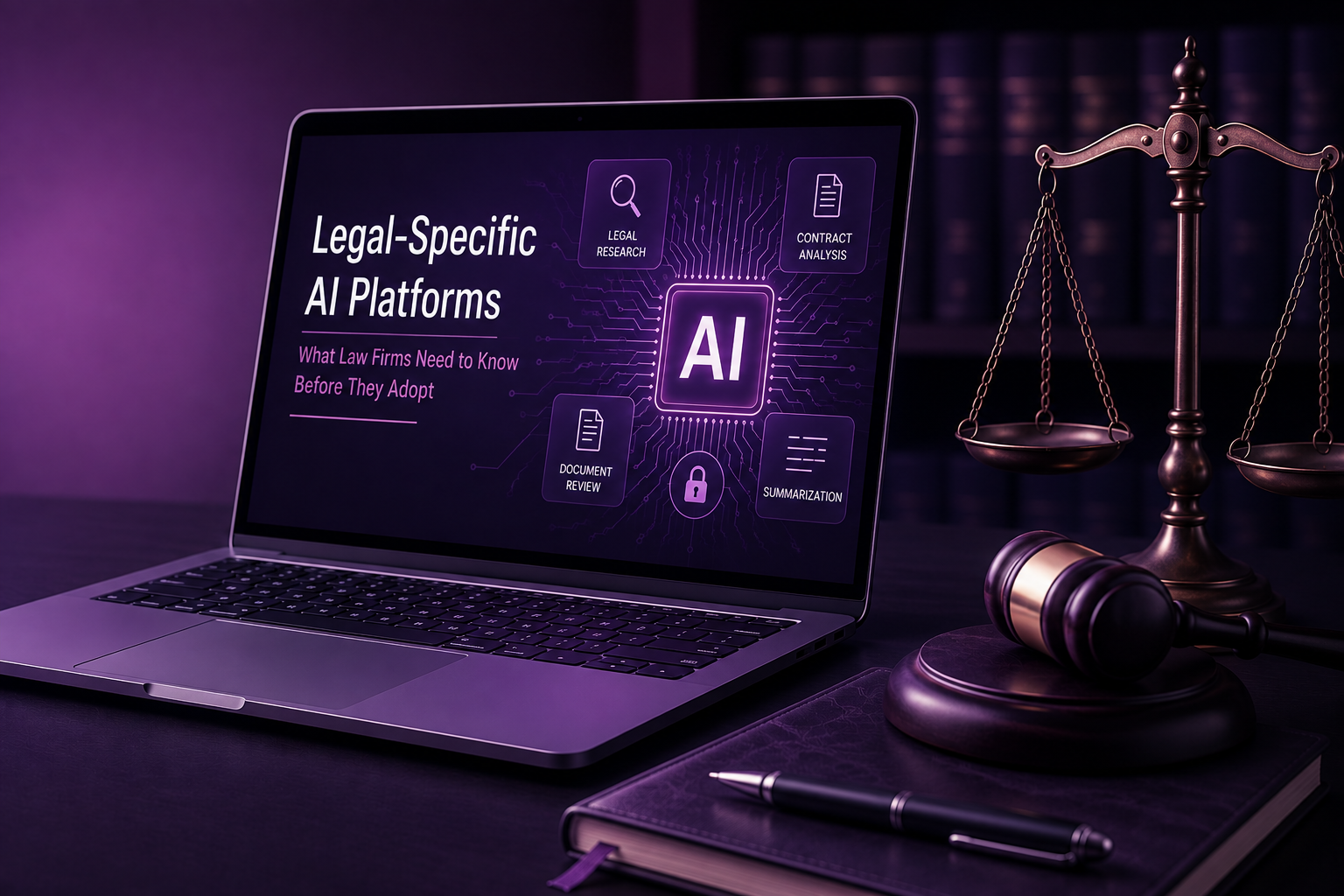
Artificial intelligence is quickly becoming part of the modern legal technology stack. But for law firms, the question is no longer simply, “Should we use AI?”
A better question is: What kind of AI belongs in a law firm?
There is an important difference between general-purpose AI tools and platforms designed specifically for legal work. Attorneys routinely handle confidential communications, privileged documents, sensitive client information, contracts, discovery materials, and other data that cannot be treated casually.
That makes choosing an AI platform more than a productivity decision. It is also an IT, cybersecurity, data governance, and risk-management decision.
What Is a Legal-Specific AI Platform?
Legal-specific AI platforms are artificial intelligence tools designed around the workflows and needs of attorneys and legal professionals.
Depending on the platform, they may help with tasks such as:
- Legal research
- Contract analysis
- Document review
- Due diligence
- Drafting and summarization
- Comparing agreements
- Extracting information from large document sets
- Organizing matter-related knowledge
The appeal is easy to understand. Instead of starting with a general-purpose AI system and trying to adapt it to legal work, firms can use technology designed with legal tasks and workflows in mind.
But “built for legal” should never automatically mean “approved for our firm.”
Every platform still needs to be evaluated carefully.
General AI vs. Legal-Specific AI
General-purpose AI tools can be incredibly capable. They can summarize information, generate drafts, analyze documents, brainstorm ideas, and automate portions of everyday work.
The challenge is that a consumer or general business AI application may not have been configured around a law firm's particular security, confidentiality, administrative, and governance requirements.
Legal-specific platforms attempt to close that gap by creating AI experiences around the work attorneys actually perform.
That distinction is becoming increasingly significant as legal AI platforms evolve beyond simple chat interfaces. Newer systems are being designed to maintain more context, work across documents, assist with multi-step workflows, and adapt more closely to how professionals work.
For a law firm, however, functionality is only one piece of the puzzle.
The First Question Shouldn't Be “What Can It Do?”
When attorneys see an impressive AI demonstration, it is natural to focus on the output.
How quickly can it summarize this agreement?
Can it identify an unusual provision?
Can it help draft a first version of this document?
Those are useful questions. Your IT and security teams need to ask another set of questions first.
What happens to the information we give it?
Before introducing a legal AI platform, firms should understand:
Where is our data processed and stored?
Know where client information travels once it enters the platform and which systems or third parties may process it.
Is our information used to train AI models?
The answer should be clearly understood before attorneys begin submitting firm or client information.
What administrative controls are available?
Your firm should be able to manage users, permissions, authentication, access, and other security settings centrally.
How long is information retained?
Data-retention practices need to align with the firm's policies and obligations.
What integrations does the platform require?
An AI platform connected to document management, email, cloud storage, or other systems can become significantly more powerful—but those connections also expand the amount of information the platform can potentially access.
Can activity be monitored and audited?
Visibility matters. Firms should understand what administrative logging and oversight capabilities are available.
These aren't reasons to avoid AI. They're reasons to implement it deliberately.
Legal AI Is Also an Identity and Access Problem
One of the biggest misconceptions about AI adoption is that it happens entirely inside the AI application.
In reality, secure adoption depends on the technology surrounding it.
Imagine an AI platform has access to your firm's document management environment. If permissions are poorly configured there, adding AI doesn't solve the underlying issue. It can potentially make information easier to find and process.
The same principle applies to compromised accounts.
Strong identity controls therefore become even more important as firms introduce AI. Multi-factor authentication, appropriate permissions, account lifecycle management, endpoint security, monitoring, and well-designed access policies all contribute to safer AI adoption.
AI security starts with good IT security.
Don't Forget the Human Side of AI
Even a carefully selected platform can create risk when employees don't know how they are expected to use it.
A firm needs clear rules.
Attorneys and staff should understand what information can be entered into approved AI systems, which platforms are authorized, what uses require additional review, and when AI-generated work needs to be independently verified.
That last point is particularly important.
AI can produce remarkably convincing output while still getting something wrong. Legal professionals should treat AI as a tool that can accelerate work—not as an unquestionable source of truth.
The attorney remains responsible for the work.
The Problem With “Shadow AI”
There is another reason law firms should develop an AI strategy sooner rather than later: employees may already be experimenting with these tools.
When organizations don't provide guidance, people often find their own solutions.
An attorney might paste text into a consumer AI application to summarize it. A staff member might upload a document to an online tool because it saves 20 minutes. Someone else might connect an AI application to their work account without realizing how much access they have granted.
Nobody needs malicious intent for this to become a security problem.
A practical AI policy, approved platforms, employee education, and appropriate technical controls can help firms replace uncontrolled experimentation with responsible adoption.
How Law Firms Should Evaluate Legal AI Platforms
There isn't one AI platform that will be right for every law firm.
A small litigation practice may have very different needs from a large corporate firm. One firm may want to accelerate contract review, while another is primarily interested in research or internal knowledge management.
Start with the business problem rather than the product.
Before selecting a platform, consider:
- Use case: What specific problem are we trying to solve?
- Data: What information will the system need access to?
- Security: Does the vendor meet our security requirements?
- Privacy: How is firm and client information handled?
- Access: Who will be able to use the system and what can they access?
- Integration: What other firm systems will connect to it?
- Governance: What policies will control acceptable use?
- Verification: How will AI-generated work be reviewed?
- Training: Do attorneys and staff understand both the capabilities and limitations?
- Value: Will the platform measurably improve the way the firm works?
The goal isn't to adopt the most AI.
It's to adopt the right AI, in the right places, with the right safeguards.
Build the Foundation Before You Build the AI Strategy
AI has enormous potential for legal professionals. It can reduce repetitive work, help attorneys navigate large volumes of information, and give firms new ways to use their institutional knowledge.
But adding AI on top of an insecure or poorly managed technology environment doesn't fix the foundation underneath it.
Before expanding AI use, firms should make sure the basics are strong: identity management, endpoint protection, data access controls, backups, cybersecurity policies, employee training, vendor management, and an overall technology strategy.
That's where having an IT partner who understands legal environments matters.
At Bespoke Technology Group, we believe technology should fit the way your firm actually works. We help law firms build secure, reliable IT environments designed around client confidentiality, productivity, compliance, and long-term business goals.
AI may be changing the tools attorneys use, but the fundamentals haven't changed: protect your clients, protect your data, and make technology decisions you can stand behind.
Considering AI for your law firm? Start with the foundation. Talk with Bespoke Technology Group about building an IT and cybersecurity strategy that prepares your firm for what's next.